
GSM/DCS/3G/4G/5G » INSTRUMENTS » BOSSRF-EXPLORER
RF Explorer 3G Combo (15 - 2700 MHz), a tool for radio frequency analysis


What is RF Explorer
RF Explorer is a family of portable, low-cost, yet high performance spectrum analyzers and signal generators. They can operate as a stand-alone handheld device, or connected to a PC for more comprehensive data analysis and device control.
There is a complete range of RF Explorer Analyzers covering a variety of bands of interest to RF equipment users and developers. They cover from 15 MHz to 2700 MHz. The performance of these devices compares favorably with other larger and more expensive equipment. It is truly revolutionary equipment in its field.
The open source PC software incorporates unique advanced features such as 2D and 3D waterfall mode:

what is this type of tool for?
This small, highly portable device is used to see what is happening in real time in the radio frequency spectrum.
Nowadays there are more and more wireless systems in live sound systems, and I really consider it more and more important to be able to analyze the electromagnetic spectrum before placing wireless systems.
It is true that practically all manufacturers give us frequency scanner options to select a free frequency, but we must remember that when we combine several systems intermodulations can appear (especially those of third order) that can create problems and that at any time someone can turn on a wireless system outside our setup, interfering with our systems.
In addition, visualizing the spectrum allows us to see where our antennas receive the signal better, and to play with the polarization (that is, the plane of the antenna with respect to the ground axis) to reduce the pickup of unwanted signals. All are advantages, although it is one more tool to carry with you, in the end the benefits end up compensating.small device, tremendously portable, serves to be able to see what is going on in the antenna.
what is the device like?
RF Explorer 3G Combo (15 - 2700 MHz) is a small and inexpensive device.
Measuring 11.3 x 7 x 2.5cm and weighing 185 grams, it is no inconvenience to add it to the sound technician's backpack.
We can incorporate the omnidirectional antenna with which it comes, or add any antenna of our wireless transmitters.
Another advantage of the device in question is that it does not run on batteries, but has a rechargeable battery through the USB port of the computer

The device in question, RF Explorer 3G Combo (15 - 2700 MHz), is barely bigger than a cell phone.
how does it work?
We can use it in two ways: Either standalone, visualizing the RFP analysisWe can use it in two ways: Either standalone, displaying the RF analysis on the small 128×64 pixel screen built into it, or by connecting it to a computer via USB cable.
The most practical option for visualization is undoubtedly through the computer, as we can have access to a much more accurate and detailed display, as well as different visualization options.
In my case, as I use Mac OSX, I have downloaded the great free application iRFExplorer that allows to show us a much higher resolution than what we can see on the small screen of the device.
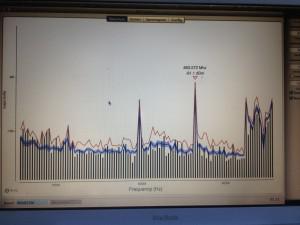
We select the frequency range we want to display and it immediately shows it on the screen. If we connect it at the place where we are going to work with wireless, we can immediately see what is happening in the RF spectrum or what signals our antennas are receiving.
If we connect it in the place where we are going to work with wireless, we can immediately visualize what is happening in the RF spectrum or what signals our antennas are receiving.
Conclusions
It is a simple and effective tool. For the price it has, the results are more than decent, but it is not an overly accurate analyzer (which is logical considering what it costs). For the work we do in our company with wireless systems it is more than enough, and although we have not taken it out of bolus for the moment, we hope to be able to use it a lot over the next few years.
In addition, the arrival of 4G may generate interference and intermodulation problems in the short term future, and it may be convenient to have a small and fast tool to see what is happening in the electromagnetic spectrum (so far invisible to me).